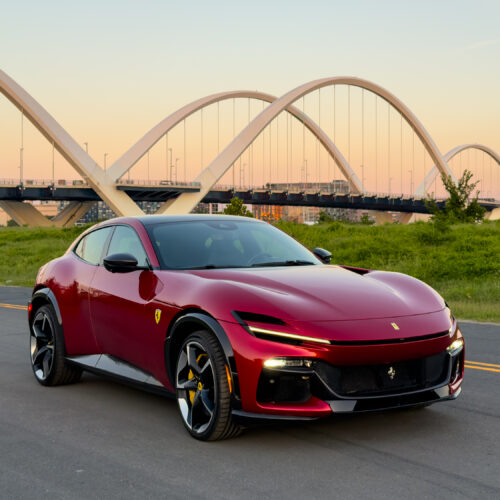
Ferrari's latest masterpiece redefines high-performance utility by prioritizing human passengers over cargo capacity, blending iconic V12 power with everyday usability. We put Maranello's groundbreaking four-seater through its paces on the historic streets of Rome.
Evolution of the Maranello Four-Seater
Ferrari's two-seat sports cars might traditionally define the brand's core identity, but the storied Italian automaker has always catered to discerning customers who want to bring more than one passenger along for the ride. This lineage started building momentum in the 1960s with the classic 250 GT 2+2; as the name explicitly suggests, that second row was primarily designed for occasional use. This philosophy remained consistent all the way through to the 612 Scaglietti in the early 2000s, where rear quarters were functional yet secondary to the front-engine grand touring experience.
Following those grand tourers, Ferrari introduced its first true four-seater, the all-wheel-drive FF, which boldly adopted distinctive "Breadvan" styling. Its pioneering hatchback architecture was still a three-door configuration, though, offering slightly more practical utility for carrying cargo rather than optimizing human comfort in the rear. That functional focus remained true for the GTC4Lusso that followed in its tread marks. However, with the arrival of the revolutionary Purosangue, rear passengers have finally been given a massive, long-overdue upgrade.
Architecture and the FUV Designation
For one thing, the Purosangue introduces an extra pair of doors - specifically, rear-hinged suicide doors that provide direct, unencumbered access to a pair of deeply contoured rear bucket seats. There is still a traditional rear hatch, meaning this is technically a five-door vehicle by strict automotive classification. Yet, looking inside reveals an immovable firewall rigidly separating the cargo area from the passenger cabin, and critically, the rear bucket seats do not fold flat.
Consequently, unlike the 21st-century breadvans previously reviewed by automotive critics, a major Costco run in the Purosangue might be possible, but you are probably going to want an external roof rack if you plan to go skiing, cycling, or engage in any outdoor lifestyle activity that requires bulky equipment. It is entirely accurate, therefore, when corporate executives at Ferrari adamantly state that the Purosangue is not a conventional SUV at all, but rather an FUV - a dedicated Ferrari Utility Vehicle.
Powertrain Engineering and Weight Distribution
Beneath that aggressively sculpted, lengthy hood lives a thunderous 6.5-liter naturally aspirated V12 engine. Ingeniously, it is mounted far back into the chassis, making this technically a front-mid-engined layout. This architectural placement heavily contributes to an idealized 49:51 front-to-rear weight ratio, a balance further optimized by the deployment of a rear-mounted transaxle gearbox handling the rear wheels through an eight-speed dual-clutch transmission.
Meanwhile, a separate power transfer unit positioned at the front of the engine drives the front wheels, cementing the vehicle's credentials as a high-performance all-wheel-drive Ferrari. Make no mistake, however, as it is a substantial machine befitting that massive 715 horsepower (533 kW) and 528 lb-ft (716 Nm) powerplant: it measures 195.8 inches (4,973 mm) long, 79.8 inches (2,028 mm) wide, and 62.6 inches (1,589 mm) tall, boasting a sprawling 118.1-inch (3,018 mm) wheelbase and a curb weight of 4,784 pounds (2,170 kg).
Urban Maneuverability and Dynamic Handling
Despite its imposing physical footprint, it doesn't take very long for the car to shrink around the driver on tight European tarmac. Earlier this summer, our editorial team spent a couple of hours driving another Purosangue around Rome on the eve of Ferrari's high-profile Luce reveal, where the vehicle coped quite ably with millennia-old, congested streets. It proves to be an astonishingly easy car to drive slowly or crawl in heavy urban traffic, despite its sheer size and immense power output.
The sophisticated stop-start system operates seamlessly even from a cold start and remains entirely unobtrusive. Furthermore, vehicle speed is exceptionally easy to modulate thanks to generous pedal travel for the throttle and an engine endowed with such deep, accessible torque that you will rarely see the tachometer climb past 2,000 rpm when cruising in Comfort mode and letting the eight-speed transmission shift for itself.
Pushing the Limits on the Open Road
That effortless urban cruising is quite a revelation, considering the fact that this high-revving engine doesn't hit its redline until a screaming 8,250 rpm. To experience that upper echelon of performance, drivers will likely want to dial into Sport mode; it stands as the most extreme performance setting available on the Purosangue, as you will not find a traditional Race mode on the steering-wheel-mounted manettino dial that toggles through drive modes, though you will find a dedicated mode for Ice instead.
Regardless of the active drive mode selected, pilots can choose to take complete control of gear changes using the large, tactile carbon-fiber paddle shifters. This can be done either to temporarily override the automated shifting function or by engaging true manual mode, selectable via a physical switch on the center console, where drivers will also locate the electronic reverse selector. The steering feel is noticeably heavier than something like a 296 GTB, yet it maintains direct, communicative feedback regarding road conditions exactly as the front tires experience them.
In Sport mode, drivers can physically feel the advanced chassis control systems and electronic differentials working in unison to tighten the cornering line if steering inputs and heavy throttle are applied simultaneously. And because the cabin features four dedicated, highly supportive seats, owners can comfortably share the visceral experience with three passengers - punctuated, in our experience, by the unforgettable squeals of delight from everyone on board.
Reporting synthesized under Nexvoro.tech Editorial Standards • Referenced via Ars Technica
Verified Dispatch