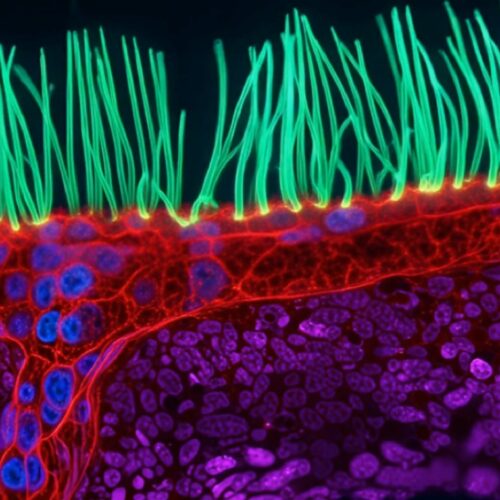
Ning Xu of Tsinghua University captured tiny cilia beating in airways of a child with rare respiratory disorder.
By Nexvoro Tech Wire
PUBLISHED FRI, SEP 18, 2026 5:41 PM UTC • 6 MIN READ
Primary Journalistic Dispatch & Direct Reporting
Ning Xu of Tsinghua University captured tiny cilia beating in airways of a child with rare respiratory disorder.
A Chinese optical engineer is the winner of this year's Small World in Motion competition, sponsored by Nikon. Ning Xu of Tsinghua University in Beijing beat out 346 other video entries from 40 different countries with his super-resolution video (above) of the abnormal beating of cilia in the airways of a child with a rare genetic respiratory disorder.
In-Depth Developments & Factual Context
Founded in 2011, the Nikon Small World in Motion competition is a spinoff of the company's Small World Photomicrography Competition, which has been around since 1974. Both are meant "to showcase the beauty and complexity of things seen through the light microscope" - one through still photographs, the other through photovideography, taking advantage of all the technological advances that now allow users to make movies or time-lapse images through the microscope.
Primary ciliary dyskinesia ( PCD ) is a genetic disorder that adversely affects the tiny hairlike structures that line the lungs, among other areas. Their wavelike motion helps move around germs, mucus, dust, and other irritants so the body can dispel them via coughing or sneezing. In people born with PCD, there is something wrong with those cilia, so those irritants build up, causing respiratory infections, among other complications. The cilia might be the wrong size, the wrong shape, or missing altogether. They might move abnormally or not move at all.
Industry Impact & Strategic Analysis
In that sense, the disease is defined by movement, so studying it requires observing those cilia in motion with video, not just still imagery. That's a challenge, given their small size and rapid movement, plus they must be imaged while still living. That rules out many advanced microscopy techniques, particularly those that rely on intense light or fluorescent dyes.
Xu is an optical engineer whose work involves developing advanced imaging systems for observing cellular structure in motion. He captured the cilia movement using diffractive super-resolution microscopy, which employs multiple light waves and a digital micromirror to precisely shape light. This minimizes how much light reaches the living sample and yet can capture the rapid cilia movement at high resolution.
Forward Outlook & Market Perspective
"To understand this disease, you need to observe around 10 seconds of motion, not just a still image," said Xu. "When people watch cilia beating, they immediately understand that something beautiful and important is happening inside us. I think this competition turns microscopy into a shared language."
Nguyen Nam Nhat of Vietnam placed second with a video of a tiny roundworm and a single-celled organism; Benedikt Pleyer of Bavaria, Germany, placed third with a video of jellyfish larvae suspended in water droplets; Andrew Moore of Howard Hughes Medical Institute in the US placed fourth with a video of synchronized cell division in neighboring cells; and Patrick Hickey of Hypha Research Ltd. in Edinburgh, Scotland, placed fifth with a video of the dynamics of mitochondria and chloroplasts in Turtle Vine leaf cells.
You can check out those winning entries along with several honorable mentions here .
Ars Technica has been separating the signal from
the noise for over 25 years. With our unique combination of
technical savvy and wide-ranging interest in the technological arts
and sciences, Ars is the trusted source in a sea of information. After
all, you don't need to know everything, only what's important.
Reporting synthesized and verified under Nexvoro.tech editorial guidelines. Full primary records referenced via Ars Technica.
Reporting synthesized under Nexvoro.tech Editorial Standards • Referenced via Ars Technica
Verified Dispatch