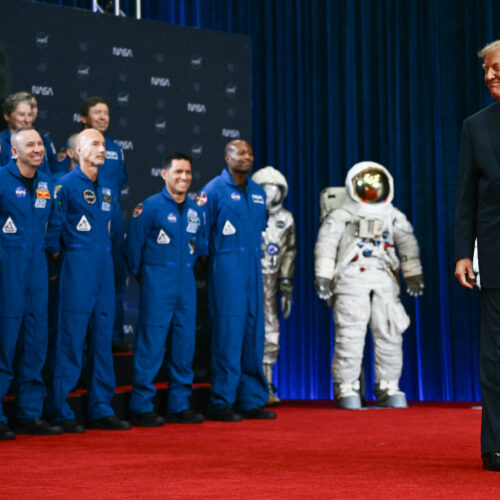
NASA asks US states to show them the money.
Primary Journalistic Dispatch & Direct Reporting
NASA has released a document that provides some initial details about the proposed United States Space Academy, and it's clear that the space agency wants to move quickly in establishing the institution.
According to the document's timeline , NASA seeks a groundbreaking for a permanent campus no later than next year, the first class to be enrolled and begin studies in temporary facilities in 2028, and a transition to a permanent campus in 2031.
NASA is seeking a permanent site with at least 300 acres for the Space Academy, which aims to "prepare a new generation of leaders to explore, build, operate, secure, and defend the space domain." Proximity to NASA facilities or university campuses could be a plus. The campus will initially support 1,200 undergraduates, with the potential to expand to up to 4,000 students.
In-Depth Developments & Factual Context
The document is called a "Request for Information," and it essentially kicks off the bidding process among US states to house the Space Academy. This is expected to be a hot competition, with states such as Texas, Florida, and Alabama expected to put forth attractive bids to the federal government.
All 50 states are invited to submit a single response, specifying their contributions such as land, infrastructure, funding, and more. Respondents are also asked to provide a "rough-order-of-magnitude" estimate of the cost to establish and operate the Space Academy at their proposed locations. Submissions are due back to NASA by October 26.
The 14-page document sets up a competition that may look something like a major corporate relocation, with states pitching packages of free land, university partnerships, state funding, and more to lure the federal government to choose their state.
Industry Impact & Strategic Analysis
Ultimately, however, this will be a political process. NASA will initially review and rate the proposals, which will then be considered by a presidential commission appointed by Donald Trump and chaired by NASA Administrator Jared Isaacman. Members of this commission include Chief of Staff Susie Wiles, Secretary of State Marco Rubio, and Secretary of Defense Pete Hegseth. Trump will make the final decision, which will likely favor red or Republican-leaning states.
Some significant questions still remain about the Space Academy two weeks after Trump announced the initiative and the special commission was created.
Perhaps most importantly is the distinction between a NASA-led, civil space academy and the US military service academies it appears to be modeled upon. The document states that the academy will produce "future scientists, engineers, astronauts, pilots, operators, entrepreneurs, civil servants, warfighters, and other leaders to advance American interests across the aerospace sector."
Forward Outlook & Market Perspective
A source familiar with the commission's thinking has told Ars that the intent is for a majority of graduates to leave the school and work for NASA, but some could opt for the US Space Force - which appears to be backed up by the stated goal of producing "warfighters." The new NASA document is silent on tuition, but Ars has been told that in return for free education, students will be expected to spend several years in government service.
So why does the United States need a Space Academy? After all, the country already has many fine academic institutions that train scientists and engineers.
The document notes that the economy and security of the United States increasingly depend on space. This is a very different world from half a century ago, when NASA was created to land humans on the Moon and explore the Solar System with robotic probes. And as space becomes more contested, another major change has come from the rising importance of commercial space companies to serve the spaceflight needs of the US government.
The continued advancement of US space interests will require a new generation of leaders with interdisciplinary backgrounds capable of responding to changes in spaceflight and leading the nation into the future. Although Trump did not formally say so during his announcement of the academy, there is also the somewhat romantic notion that the United States needs a "Starfleet Academy" as humans become an increasingly spacefaring species.
The aggressive timeline to create the academy also reflects a recognition of the political times. For now, Trump and his fellow Republicans control the White House and both houses of Congress. That may change with the midterm elections in November, when Democrats have an opportunity to take back the House and Senate.
The call for the Space Academy's creation has produced a mixed reaction from Democrats. Perhaps most critical was Sen. John Hickenlooper (D-Colo.), who called the plan "duplicative, costly, and unserious." This is perhaps not surprising given that the new institution could compete with the US Air Force Academy in Colorado. "To duplicate that effort at a time when our national deficit is soaring is reckless and makes a dire situation even worse," he said.
Reporting synthesized and verified under Nexvoro.tech editorial guidelines. Full primary records referenced via Ars Technica.
Reporting synthesized under Nexvoro.tech Editorial Standards • Referenced via Ars Technica
Verified Dispatch