Scaleout deploys decentralized AI-driven learning to military bases and drones.
By Nexvoro Tech Wire
PUBLISHED FRI, SEP 18, 2026 5:27 AM UTC • 6 MIN READ
Primary Journalistic Dispatch & Direct Reporting
Scaleout deploys decentralized AI-driven learning to military bases and drones.
As European militaries adapt to the use of AI and drones in modern warfare, a NATO-backed startup is helping to deploy AI-driven target detection and selection that can run on small drones for surveillance and attack missions.
The company Scaleout Systems was originally founded by researchers from Uppsala University in Sweden in 2018, and initially focused on training and deploying machine learning models directly on the hardware available in commercial trucks and other vehicles. But once Russia launched its full-scale invasion of Ukraine in 2022, the company pivoted toward defense applications.
In-Depth Developments & Factual Context
"With the war in Ukraine and a shifting world, we realized that this technology can be very important to operationalize edge data and sensor data for machine learning to make sure that NATO allies have found that strategic advantage," Andreas Hellander, cofounder and CEO of Scaleout Systems, told Ars.
Instead of using frontier AI models from OpenAI or Anthropic , Scaleout is harnessing leaner ones, such as machine learning models that can perform computer vision tasks on the hardware of drones or computers used at forward bases. "They need to fit on forward-deployed hardware and edge hardware, which can vary quite a bit from small embedded devices to quite powerful edge workstations," Hellander said.
Scaleout was selected to join NATO's Defence Innovator Accelerator for the North Atlantic (DIANA) Challenge Program in 2025. There, it has worked on the Federated Aerial Intelligence for Recon project to adapt machine learning models for the edge computing hardware found in drones, drone pilot tablets, and field command posts.
Industry Impact & Strategic Analysis
Such AI models can help the drone operators with tasks such as target identification, even as the drone's cameras and sensors collect data from the surrounding battlefield environment. They can then intermittently share selective updates with computing nodes at the local platoon or company headquarters without transmitting sensitive raw data.
Those headquarters computing nodes help to retrain the AI models on the new battlefield data aggregated from multiple sources, before pushing the updated capabilities out to the edge devices when the opportunity arises.
"Models might have been trained in a desert environment, and if we try to deploy them in an urban environment, they're not going to perform well," Hellander told Ars. "If we can release several new versions of this model that - during the course of a single day or certainly an operation - keep learning and keep improving from this massive amount of sensor data that is generated at a practical edge, that is the sustainable advantage."
Forward Outlook & Market Perspective
The technology means military drones and devices could benefit from local AI models that operate independently without relying on continuous communications with a central server hosting larger AI models in a data center. Reliance on a centralized location to run AI models looks riskier at a time when large data centers have been targeted and destroyed during the war between the US and Iran .
This approach is also incredibly useful on modern battlefields where electronic warfare and enemy jamming can frequently interfere with communication signals. A growing number of Ukrainian military drones are already incorporating onboard AI capabilities into cheap kamikaze drones .
"We built a functioning concept of how we do this for a surveillance and reconnaissance system based on a drone," Hellander told Ars. "This is something we have also done in public demonstrations in Sweden."
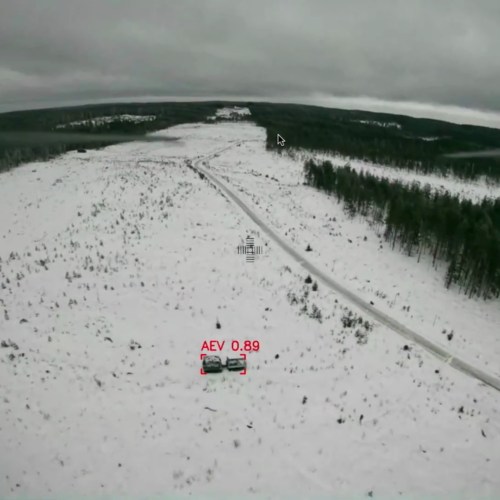
Scaleout is participating in the Affordable Loitering Modular Ammunition (ALMA) project headed by BAE Systems Bofors that aims to develop a low-cost, autonomous kamikaze drone. The ALMA concept was first publicly demonstrated during a Winter Demo 2026 event held in Sweden in January.
That demonstration showed how a drone could autonomously "detect, identify and geolocate all potential spotted threats with the use of AI," according to a Scaleout Systems presentation about ALMA's capabilities. "All data is handled by dedicated onboard computing, allowing the system to perform in real-time without any external processing."
Using its onboard AI capabilities, the drone automatically prioritized the highest-value target as defined by its mission - in this case, an armored engineering vehicle - and flew to that target to drop an explosive on it. A human operator could still control and direct the drone, but the drone carried out the mission on its own without direct human commands.
Reporting synthesized and verified under Nexvoro.tech editorial guidelines. Full primary records referenced via Ars Technica.
Reporting synthesized under Nexvoro.tech Editorial Standards • Referenced via Ars Technica
Verified Dispatch