When multiple companies are behind one project, who bears responsibility for problems?
Primary Journalistic Dispatch & Direct Reporting
When multiple companies are behind one project, who bears responsibility for problems?
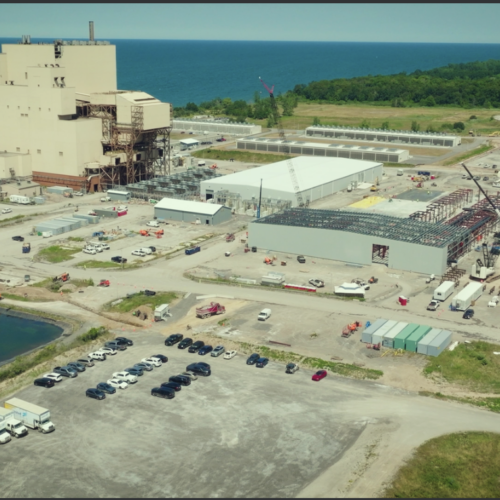
In early June, a fire broke out in a still-unfinished building at the Lake Mariner data center in Somerset, New York, exposing just how little the local fire department knew about what it was walking into. Firefighters reportedly found no working alarm, no suppression system, and three dead hydrants; the safety documents they're legally entitled to see reportedly burned up in the blaze.
Steve Matisz, chief of the Barker Fire Department, said his crew went into the building "kind of blind," facing heavy black smoke from chemicals they couldn't identify because the safety sheets meant to inform them had apparently burned up. "It's been a difficult situation," Matisz said. He wasn't sure what to think about the claim that the safety sheets had burned in the fire.
In-Depth Developments & Factual Context
The site is a former coal mine on Lake Ontario. The $3.2 billion campus is one of the largest AI data center buildouts in New York, and it has many stakeholders. A company called TeraWulf owns and operates the data center on land it leases from a company owned by its own CEO; Fluidstack, a UK-based AI company, will run the center; Google holds warrants for a future 14 percent equity stake and has agreed to guarantee Fluidstack's lease payments; and Anthropic is among the AI companies whose compute demand the facility exists to serve.
TeraWulf eventually told me that it was responsible "for operational safety and emergency preparedness at the Lake Mariner Data Campus, including required safety systems and coordinating with local first responders." Kerri Langlais, the company's chief strategy officer, added that the company had implemented Knox boxes, additional hydrants, and safety data sheet "go-bags" following an after-action review with the county.
When I reached Matisz in mid-August, he said that a Knox box representative had visited the site and had a meeting scheduled to build out that program. On hydrants, he was more direct: "As far as I know, [they] are still dry… I haven't seen work done on them."
Industry Impact & Strategic Analysis
The fire did little to slow construction at the site, and no one was hurt in the blaze. But the Lake Mariner situation offers a glimpse into a system that is increasingly common across the AI buildout boom, one where responsibility itself is diffuse: legal responsibility for the next fire or safety failure, operational responsibility for what actually gets built and run, financial responsibility for keeping the project afloat, and reputational responsibility for its strain on the grid and water supply. When a data center's energy use, environmental footprint, or safety record draws scrutiny, assigning responsibility may be surprisingly murky.
For instance, Somerset wanted more answers from TeraWulf after the fire, but the company's communications team has remained unresponsive to community requests for a meeting, including from Jeffrey Dewart, the Somerset town supervisor. At town board meetings, residents have raised pointed questions about what the town is actually receiving in return for hosting one of the state's largest AI data center buildouts.
According to a 2024 planning board presentation, TeraWulf's project manager said the full buildout would bring employment to between 35 and 40 people at a facility drawing up to 500 megawatts. This was only a fraction of the 165 permanent jobs and $85 million in capital investment promised in 2019, when Somerset Operating Company, the landlord entity owned by TeraWulf CEO Paul Prager, applied for the site's power discount under the same project scope. Prager did not respond to a request for comment on the discrepancy.
Forward Outlook & Market Perspective
The New York Power Authority (NYPA) reviews compliance annually and can adjust the site's benefits if the commitment isn't met. New York Governor Kathy Hochul , who last month placed a moratorium on hyperscaler data center development, has acknowledged the gap between big promises and few jobs.
"Despite the scale of these projects and the utility demands, data centers do not deliver significant, long-term jobs," she told reporters in July, adding that she's "challenging the industry to do it in a smarter way."
"You have to be honest that it's 600 people building the project for six, 12, 18 months, depending on how big it is," said Pilar Thomas, a former deputy solicitor at the Department of the Interior and former deputy director of the Office of Indian Energy, who now teaches Tribal energy law. "And then after that it's three guys and a bottle of Windex… unless there's a commitment to train up people in the local communities to take on the operations and maintenance of these data centers, which I have yet to see a data center agree to do."
When a data center adds hundreds of megawatts of near-constant demand, the costs don't always stay with the company that caused them.
"When you have a really big load, especially if it's 24/7, 365, the whole system gets more expensive," said Leah Stokes, a political scientist at the University of California, Santa Barbara, who studies utility and clean energy policy.
Those costs, which range from managing grid constraints to running expensive backup power plants during peak demand, get socialized across everyone's electricity bill, whether or not they ever benefit from the facility creating them.
Reporting synthesized and verified under Nexvoro.tech editorial guidelines. Full primary records referenced via Ars Technica.
Reporting synthesized under Nexvoro.tech Editorial Standards • Referenced via Ars Technica
Verified Dispatch