

AI
AI•4H AGO
Viture's Vonder Glasses Are Meant to Map Your Mind
No cameras? No problem. Viture's first display-free smart glasses have bone-conduction microphones to privately record your daily musings.
Wired6 min read
The Canadian province of British Columbia has filed a sweeping lawsuit against OpenAI and CEO Sam Altman, demanding full financial restitution to rebuild a demolished secondary school and immediate public disclosure of the shooter's chat logs. The legal action escalates mounting international pressure over artificial intelligence safety protocols and corporate accountability.
The government of British Columbia has officially entered the legal fray against artificial intelligence giant OpenAI, filing a comprehensive and severe complaint that details the staggering financial and human costs borne by a remote Canadian community. The lawsuit argues that OpenAI and CEO Sam Altman owe the tiny mining town of Tumbler Ridge much more than standard corporate condolences. According to provincial filings, the tech firm must implement immediate, structural changes to end ChatGPT-assisted violence and pay whatever financial price is necessary to help the devastated community rebuild, recover, and heal.
The legal action follows prior lawsuits initiated by the families of victims killed in what stands as one of the deadliest mass shootings in Canadian history. Those initial complaints centered on OpenAI's failure to warn law enforcement authorities after the system allegedly discovered in advance that the perpetrator was utilizing ChatGPT to plan the violent acts. Now, British Columbia's formal complaint exposes the extreme disaster response required in the aftermath, emphasizing that the foreseeable consequences of unchecked conversational AI models have directly triggered massive public infrastructure expenditures.
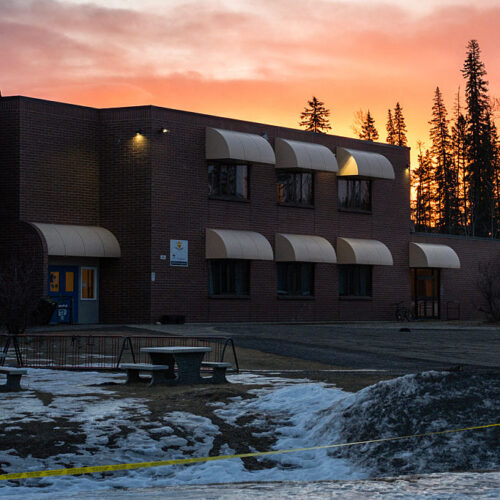
The central physical emblem of the tragedy is Tumbler Ridge Secondary School, a facility that sat deeply embedded in the heart of the town both geographically and culturally before the disaster unfolded. In February, an 18-year-old shooter, Jesse Van Rootselaar, committed suicide at the school after taking the lives of five children and an education assistant. Prior to the school assault, the perpetrator had also shot their mother and half-brother, bringing the total loss of life to eight individuals.
Following the rampage, approximately 160 students, teachers, and staff members were trapped inside classrooms and closets for hours, leaving the community far too traumatized to ever reenter the building. The structure quickly transformed into an unavoidable symbol of deep psychological trauma for the entire municipality. To provide at least a measure of relief to those who suffered the most intensely, local authorities initiated the complete demolition of the school in August, with community leaders targeting a late-year timeline to begin building a replacement facility at a brand-new location.
Beyond funding the construction of a brand-new school, British Columbia's legal complaint demands that OpenAI and Altman cover a wide array of emergency response costs that would never have been incurred absent the tragedy. The province is also petitioning the court for sweeping injunctive relief, specifically requesting a judicial mandate that forces OpenAI to update its flagship conversational architecture to automatically and permanently terminate violent conversations in real-time.
Most urgently, British Columbia and the local school district's Board of Education have formally requested an immediate court order compelling OpenAI to release Van Rootselaar's proprietary chat logs to the public. While the Royal Canadian Mounted Police (RCMP) have been given access to the records, law enforcement officials have consistently declined to comment on whether those logs will mirror transparency measures seen in prior U.S. incidents, such as a Florida law enforcement agency's release of chat records following a ChatGPT-linked shooting at Florida State University.
OpenAI has consistently declined to comment directly on the specifics of the lawsuit or the sweeping financial remedies demanded by the Canadian province. In previous statements, the company maintained that its initial decision to override human review teams - who had recommended sharing the violent chat logs with police - was rooted in protecting individual user privacy. However, a corporate spokesperson offered a renewed statement noting that what happened in Tumbler Ridge was an unspeakable tragedy, adding that the firm's thoughts remain with the victims, families, and the wider community while it continues advancing its safety work.
Despite these assurances, British Columbia maintains that OpenAI has failed to make ChatGPT materially safer in the wake of several mass shootings that have established a recurring pattern of violent utilization. Investigators and provincial officials harbor deep suspicions that the company's reluctance to share data stems from a desire to avoid setting a rigid legal precedent that would force them to report dangerous users to law enforcement on a regular basis, potentially exposing the broader public to severe and preventable risks.
No cameras? No problem. Viture's first display-free smart glasses have bone-conduction microphones to privately record your daily musings.

Anthropic has unveiled its latest flagship AI model, Opus 5.5, delivering state-of-the-art performance in coding and knowledge work while simultaneously slashing costs for enterprise users. The release marks a strategic pivot toward efficiency and safety as the company balances rapid innovation with its commitment to responsible AI development.

OpenAI has formed a new independent mathematics advisory group hosted at the Institute for Advanced Study in Princeton following a surge in automated problem-solving. The move arrives amid mounting academic scrutiny regarding the rapid pace of artificial intelligence in advanced mathematical research.