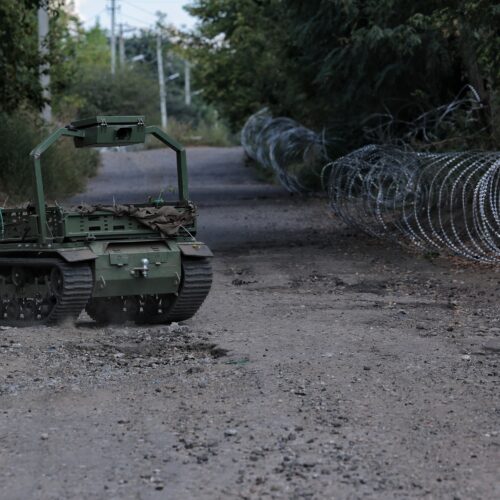
Leaning heavily on a world-first robotic airborne assault and autonomous mine-clearing systems, Ukraine's Third Army Corps has successfully erased Russian territorial gains. The high-stakes counterattack has liberated dozens of square miles and dismantled a dangerous northern pincer movement.
By Nexvoro Tech Wire
PUBLISHED THU, SEP 24, 2026 7:33 PM UTC • 7 MIN READ
A World-First Robotic Airborne Assault Behind Enemy Lines
In a landmark tactical development that blurs the line between science fiction and modern military doctrine, Ukraine's Third Army Corps revealed a world-first airborne assault involving advanced ground robots and heavy bomber drones. Executed deep within Russian-held territory on September 21, 2026, and documented by the Ukrainian government media platform United24, the operation utilized heavy-lift drones to air-drop explosive ground robots more than six miles behind Russian frontlines. This innovative deployment strategy allowed the wheeled ground robotics units to successfully bypass formidable terrain and heavily fortified enemy defenses, putting them in prime position to strike critical supply lines in the Russian rear.
While the Ukrainian military has previously utilized heavy drones to transport unmanned systems closer to target zones, this particular maneuver stands as the most ambitious robotic airborne assault recorded to date. The deployment underscores a rapidly accelerating technological arms race where autonomous and remote-controlled hardware play a pivotal role in asymmetric warfare. By leaping over entrenched positions via air transport, these ground systems circumvent the traditional bottlenecks of surface-level breaching operations, minimizing direct exposure for human personnel while maximizing logistical disruption.
Military analysts and technology observers note that such deployments highlight the evolving architecture of modern tactical robotics. The ability to integrate aerial delivery systems with terrestrial combat units points toward a future of multi-domain unmanned coordination. As production scales and hardware resilience improves, forces worldwide are examining how air-dropped ground assets can reshape frontline penetration strategies, transforming what was once purely speculative defense technology into active, frontline combat reality.
Autonomous Demining and Frontline Risk Mitigation
Beyond high-profile airborne strikes behind enemy lines, ground robotics are fundamentally transforming everyday frontline engineering tasks, most notably through autonomous mine-clearing operations. Several days after the aerial deployment, the Ukrainian defense media outlet Militarnyi reported that the Third Army Corps had independently deployed a separate fleet of ground robots to safely clear antipersonnel mines from more than 18 miles of vital supply and transit routes. This systematic clearance successfully paved the way for subsequent Ukrainian infantry assaults without risking human lives.
To put the operational efficiency of these systems into perspective, the exact same scope of demining work would have typically required the sustained deployment of two specialized sapper companies. Instead, autonomous and remote-controlled units handled the dangerous task entirely on their own. According to follow-up coverage by United24 and assessments from Militarnyi, remote-controlled robots and their human operators currently shoulder approximately 60 percent of all mine-clearing operations within the Third Army Corps' designated area of operations.
The large-scale integration of these platforms has become an absolute necessity for the Ukrainian military as it seeks to compensate for persistent manpower disadvantages relative to Russian forces. With the constant, lethal threat of enemy drone surveillance and precision strikes hovering directly over the front lines, deploying robots for hazardous duties - ranging from explosive route clearance to daily supply runs and the evacuation of wounded soldiers - has preserved precious combat power and maintained operational momentum in high-attrition zones.
The Strategic Success of Operation Vivaldi and Territorial Recovery
The cumulative impact of these advanced robotic systems has materialized in the sweeping success of Operation Vivaldi, a major counteroffensive launched by the Ukrainian Third Army Corps in May 2026. Through this operation, Ukrainian forces have successfully reclaimed up to 96 square miles of occupied territory. Crucially, the offensive has defeated and pushed back Russian forces comprising the northern sector of a pincer movement designed to encircle Ukraine's strategic "Fortress Belt" cities situated in the eastern region of the country, according to assessments published by the Institute for the Study of War (ISW).
A defining characteristic of Operation Vivaldi has been its rigorous operational security. The Third Army Corps maintained strict operational silence, keeping its successful tactical advances under wraps for an extended period. This deliberate informational blackout effectively misled Russian military leadership, whose overall operational awareness was further severely handicapped by what the ISW characterized as a "pervasive culture of lying within the Russian military" regarding true battlefield conditions during periods of retreat or failure.
Furthermore, the operational environment has been heavily influenced by Ukraine's broader intermediate-range drone strike campaign targeting vital Russian fuel infrastructure. These precision strikes significantly reduced the availability of diesel fuel required to power the generators running Russian electronic warfare (EW) systems. Simultaneously, Ukraine's domestic EW capabilities successfully neutralized roughly 20,000 Russian drones, enabling Ukrainian forces to achieve a decisive state of tactical drone overmatch while spearheading mechanized advances toward Lyman in the Donetsk Oblast.
Evolving Battlefield Dynamics and Ongoing Contestation
The shifting balance of technology and attrition has forced notable adjustments from both militaries along the eastern axis. Members of Russia's elite drone unit, known as Rubicon, were forced to withdraw from the region after the Ukrainian Third Army Corps systematically inflicted heavy losses on the unit's specialized drone pilots and exhausted its critical resources, as reported by The Kyiv Independent. This localized defeat highlights the vulnerability of specialized tactical units when confronted with resilient, technologically adaptive defense networks.
Despite these setbacks, the broader conflict remains fiercely contested. The Russian military continues to redirect armored vehicle columns and reconstituted drone units, including elements of the Rubicon formation, toward Dobropillya within the Donetsk Oblast. The ongoing movement of armor and specialized operators signals that Moscow remains committed to sustaining pressure in the sector, setting the stage for continued mechanized and technological friction.
As the conflict grinds forward, the intersection of advanced robotics, artificial intelligence-adjacent drone coordination, and electronic warfare will likely define the parameters of operational success. Ukraine's ability to leverage autonomous systems for supply drops, demining, and direct combat defense demonstrates a paradigm shift in military science. For defense technologists and military strategists alike, Operation Vivaldi serves as a definitive case study in how agile innovation can alter the strategic calculus against a numerically superior adversary.
Reporting synthesized under Nexvoro.tech Editorial Standards • Referenced via Ars Technica
Verified Dispatch