By Nexvoro Tech Wire
PUBLISHED THU, SEP 10, 2026 2:00 PM UTC • 6 MIN READ
Primary Journalistic Dispatch & Direct Reporting
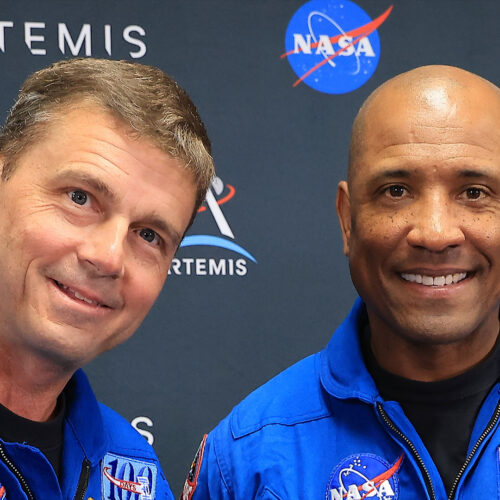
The commander and pilot of NASA's Artemis II mission have gained a new distinction five months after splashing down from the Moon: They're not fully retiring from the space agency.
Reid Wiseman and Victor Glover are the first astronauts to join NASA's emeritus program , enabling them to continue to support the work being done at Johnson Space Center in Houston. They will remain available to train and mentor the current workforce while still being able to pursue employment and opportunities outside of NASA.
"I have asked NASA … to not use the term 'retire' as much, but technically emeritus is a retirement program," Glover told collectSPACE.com on Wednesday. "It's something we have typically done for scientists when they have groundbreaking research, and they want to go back to academia to teach or to research and publish."
In-Depth Developments & Factual Context
Glover has accepted a full-time administrative leadership position at his alma mater, California Polytechnic State University (Cal Poly) in San Luis Obispo, helping shape the school's long-term strategies. Concurrently, he has committed to NASA to be available to convey his knowledge of the Orion spacecraft and its systems, among other expertise, to future Artemis missions.
"You can be paid or you can be a gratis service, which is compensation waived, and that's what I'm doing," Glover said. "So I'm not going to be paid for it, but I'll be able to voluntarily be an advisor or a consultant providing insight into what living in Orion is like."
Glover will be issued an access badge and plans to be present at the training simulation runs and hopes to be a part of establishing a new initiative, the United States Space Academy, serving NASA and the US Space Force.
Industry Impact & Strategic Analysis
"I want to work on that as they start building its foundation because that signals exactly what I care about: building the future of the technical workforce leaders," he said. "So this is really amazing timing."
According to NASA, Wiseman also plans to use his emeritus status to continue sharing his spaceflight experience with his now-former colleagues ahead of the Artemis III mission, targeted for no earlier than mid-2027. The Artemis III crew will test Orion's rendezvous and docking capabilities with commercial human landing systems in low-Earth orbit.
Historically, when astronauts wanted to join private industry, run for public office, or return to military service, they retired from NASA. If they wanted to remain at the space agency but were no longer eligible for a flight assignment, either temporarily or permanently, they were categorized as management astronauts.
Forward Outlook & Market Perspective
Mercury astronaut Scott Carpenter took a leave from NASA to briefly become an aquanaut. From August to September 1965, he lived on the ocean floor in the Navy's SEALAB II. He then returned to the space agency, though due in part to an arm injury he sustained while away, he worked in management positions until he resigned in 1967.
Edward Gibson, who flew on the third and last Skylab mission in 1974, resigned from NASA after returning to Earth. Three years later, he returned to the astronaut office as chief of the scientist-astronaut candidates. He had hoped to fly another mission, but ultimately retired from the agency again in 1982.
Similarly, Tony England was selected as a scientist-astronaut in 1967, but left five years later due to the lack of available flight assignments. England returned as a mission specialist in 1979 and flew on STS-51F, a 1985 Spacelab mission aboard the space shuttle Challenger . He retired from NASA for the second time in 1988.
Anna Lee Fisher, one of NASA's first six female astronauts and the first mother to fly in space, took an extended leave from 1989 to 1995 to raise her family. The leave was decided on a year-to-year basis. Like Carpenter, Fisher did not fly into space again after her return, but oversaw the design and development of hardware for the International Space Station and Orion spacecraft before retiring in 2017.
Other astronauts, such as Sally Ride and Neil Armstrong, continued to serve the space agency long after their retirement by volunteering their time on blue-ribbon committees that investigated the loss of two space shuttles and studied the direction of the space program.
What separates what Wiseman and Glover are doing from what other astronauts have done is the formality of the service.
Reporting synthesized and verified under Nexvoro.tech editorial guidelines. Full primary records referenced via Ars Technica.
Reporting synthesized under Nexvoro.tech Editorial Standards • Referenced via Ars Technica
Verified Dispatch