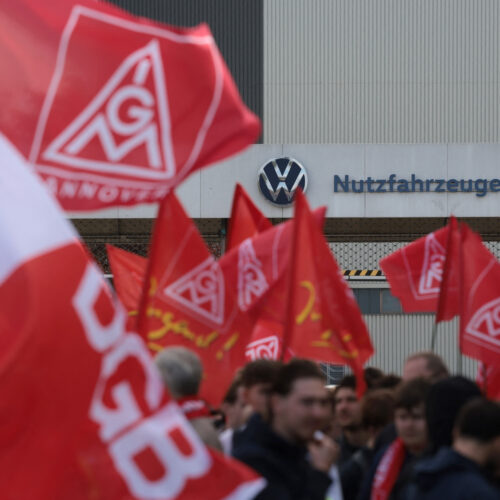
Germany's legendary carmakers are confronting an unprecedented structural crisis, triggering mass worker protests across iconic brands like Volkswagen, Mercedes-Benz, and Porsche. Plummeting European sales, aggressive Chinese market entrants, and punitive 25 percent US import tariffs have pushed the nation's economic engine to the brink of factory closures.
By Nexvoro Tech Wire
PUBLISHED TUE, SEP 22, 2026 5:22 PM UTC • 6 MIN READ
The Macroeconomic Squeeze on the German Economic Engine
For nearly a quarter of a century, the automotive industry has stood proudly as the undisputed crown jewel of the German economy, punching significantly above its weight class in terms of capital investment, industrial innovation, and global prestige. However, the future of this foundational sector is looking increasingly bleak as executives and boardrooms grapple with a brutal convergence of headwinds. Carmakers are currently facing multiple severe challenges simultaneously, ranging from declining domestic demand and stronger competition from abroad to the steep financial burden of punitive and arbitrary new international tariffs.
These acute pressures arrive on top of preexisting structural challenges that have steadily eroded profit margins, including an aging domestic workforce and a sluggish, uneven recovery from the disruptions of the COVID-19 pandemic. Total automotive sales across Europe have suffered a dramatic decline, falling from a robust peak of almost 18 million vehicles in 2019 down to an estimated 13 million by 2025. A growing share of this significantly smaller regional market is increasingly being captured by aggressive new market entrants from China, which is simultaneously grappling with its own domestic spare automotive production capacity problem.
Compounding these continental troubles, the United States market has historically served as the single most lucrative destination for profitable German car exports. That foundational dynamic shifted dramatically with the imposition of aggressive new import tariffs, which currently stand at a punishing 25 percent and remain subject to unpredictable fluctuations at any given moment. This volatile geopolitical and regulatory landscape has fundamentally disrupted long-term financial forecasting for every major Original Equipment Manufacturer (OEM) headquartered in Germany.
VW Group's Porsche Miscalculation and Massive Write-Downs
Against this unforgiving economic backdrop, the prospect of factory closures - once entirely unthinkable in modern German industrial history - now appears not just possible, but increasingly likely. Earlier this summer, alarming news emerged indicating that the Volkswagen Group is actively considering closing four of its domestic factories in Germany to restructure and prepare for an uncertain future. Unfortunately, operational and market conditions have not improved for the sprawling VW Group in the months since that initial disclosure rattled European markets.
A significant driver of this financial distress is Porsche. The Volkswagen Group has owned the Stuttgart-based legendary sports car maker since 2008, following a dramatic reversal of fortune that upended a failed hostile takeover bid by Porsche to absorb its larger rival. For many years, Porsche functioned as an extraordinary cash cow, generating outsized, highly reliable profits for its corporate parent. However, sales in the critical Chinese market have slowed down precipitously.
Furthermore, much like numerous other traditional OEMs, Porsche bet far too heavily and far too soon on the rapid global transition to electric vehicles. While Porsche's current EV lineup consists of undeniably competent engineering marvels, the company is currently building far too many units while selling far too few to justify the production volume. As a direct consequence of this imbalance, Porsche's profit margin recently plummeted below that of Skoda, the group's budget-friendly brand.
Multi-Billion Dollar Writedowns and Drastic Workforce Reductions
This severe margin compression is a primary catalyst behind the staggering financial blow delivered late last week. VW Group was forced to execute a massive $11.5 billion (€10 billion) write-down on Friday, with a staggering $6.9 billion (€6 billion) directly resulting from the diminished valuation of its 75 percent controlling stake in Porsche. Facing the stark reality of a profoundly difficult 2026 fiscal year, Volkswagen leadership is preparing to dramatically accelerate its timeline for aggressive workforce reductions.
"I had hoped that the measures agreed in 2024 would already be sufficient. Unfortunately, that has not been the case. We have absolutely no time to lose and will therefore significantly step up our performance program," VW brand head Thomas Schaefer bluntly told an internal staff meeting, signaling that deeper cuts are virtually guaranteed. The pressure on labor is immediate, widespread, and escalating across the entire German industrial base.
It is worth noting that VW Group is far from alone in confronting these grim operational realities. Today, Mercedes-Benz officially became the latest major OEM to issue a dire warning to its workforce, communicating that management may be forced to shutter "one German assembly plant and one German powertrain plant" unless the organization can rapidly identify and execute vital cost-saving measures.
Nationwide Labor Protests and the Future of German Manufacturing
The boiling point of this industrial crisis was reached as thousands of fed-up workers took to the streets in coordinated protests. Demonstrations erupted outside facilities belonging to Audi, BMW, Mercedes-Benz, Porsche, Volkswagen, and numerous critical tier-one supply chain partners, underscoring the solidarity of the labor movement.
"We expect corporate leaders and management teams to take responsibility for Germany as an automotive nation, for employees and for jobs," demanded Christiane Benner, head of the influential IG Metall union, which spearheaded the widespread protests. The union's stance highlights the tense standoff between executive efforts to preserve corporate solvency through downsizing and labor's demand to protect historical employment guarantees.
As Germany's legendary car industry navigates this perilous crossroads, the decisions made in the coming quarters will determine whether the nation's automotive crown jewels can successfully reinvent themselves or face a permanent erosion of industrial dominance. With international trade tensions persisting and technology transitions stuttering, the path forward remains fraught with unprecedented economic peril.
Reporting synthesized under Nexvoro.tech Editorial Standards • Referenced via Ars Technica
Verified Dispatch