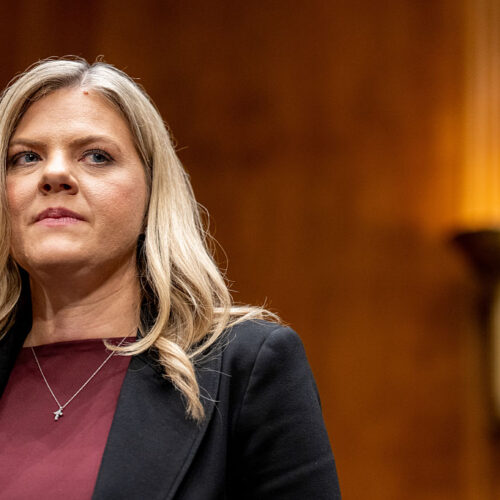
During a contentious two-hour confirmation hearing before the Senate health committee, President Trump's FDA nominee Dr. Heidi Overton repeatedly sidestepped questions regarding whether the president has ever been wrong on scientific matters, specifically avoiding direct repudiation of his discredited claims surrounding the MMR vaccine and prenatal Tylenol use.
By Nexvoro Tech Wire
PUBLISHED SAT, SEP 26, 2026 6:38 AM UTC • 7 MIN READ
The Senate Confirmation Showdown
President Donald Trump's nominee to lead the Food and Drug Administration (FDA), Dr. Heidi Overton, faced sharp, sustained questioning during a high-stakes confirmation hearing before the Senate health committee. Overton, a physician possessing a doctoral degree in clinical investigation who currently serves as the deputy assistant to the president for domestic policy, spent nearly two hours stonewalling senators on critical public health inquiries. Her background includes prior work at a conservative think tank, which has previously fostered rigorous scrutiny regarding her ideological alignment and objectivity on reproductive health matters, given that the FDA is actively reviewing the safety of the abortion pill, mifepristone, despite extensive empirical data demonstrating its high safety profile.
The proceedings quickly intensified as lawmakers shifted focus from administrative responsibilities to fundamental questions of scientific integrity and executive deference. Throughout the nearly two-hour session, Overton confronted detailed inquiries centering on highly sensitive public health topics, including childhood vaccinations, flavored electronic nicotine delivery systems, hormonal birth control, and reproductive rights. Senators on both sides of the aisle pressed for clear commitments regarding whether the agency under her prospective leadership would remain entirely insulated from political pressures and anchored strictly in peer-reviewed clinical science.
Contradicting the White House on Vaccine Safety
The nomination hearing brought to light direct tensions between Overton's professional medical consensus and previous statements made by the commander-in-chief. Overton notably stood behind President Trump at a press conference in August during which the president publicly characterized the measles, mumps, and rubella (MMR) vaccine as "quite lethal." Furthermore, Trump asserted during the same appearance that routine vaccine doses administered to infants are "like the size of a soda bottle," while explicitly calling for the combined MMR immunization to be split into three separate individual inoculations. Medical experts note there is zero clinical evidence demonstrating any benefit from such a separation, nor are individual MMR component immunizations currently available within the United States.
Under direct questioning from committee members, Overton explicitly contradicted the administration's past rhetoric on multiple occasions. She stated unequivocally at various points during the proceedings that "the MMR vaccine is not lethal" and affirmed that "the MMR vaccine is safe and effective." These acknowledgments highlighted a distinct divergence between the nominee's stated clinical understanding and the controversial public health assertions previously championed from the executive podium, setting the stage for a dramatic series of confrontations regarding executive infallibility and public trust in federal health regulators.
Evasiveness on Presidential Infallibility
The pivotal moment of the hearing arrived when Senator Maggie Hassan (D-NH) pressed the nominee on the psychological and political mechanics of advising the executive branch. Senator Hassan directly asked, "Do you think it's possible for the president to ever be wrong about something?" Rather than offering a direct affirmative or negative response, Overton deployed a practiced non-answer, beginning with the statement: "I've had the privilege of working for the president for over a year and a half and have had robust discussions with him."
When Senator Hassan immediately cut her off and repeated the core inquiry - "Is it possible for him to be wrong?" - Overton remained consistently evasive. Senator Hassan then connected the abstract question of executive error directly to tangible public safety, asking whether the president was incorrect when he suggested the MMR vaccine might be lethal. While Overton reiterated that the vaccine is safe and effective, she continually deflected when asked explicitly if the president's previous warnings constituted an error, stating, "Senator, the president asks questions and wants the best outcomes for the American people right now."
The Tylenol and Autism Controversy
Senator Hassan continued her line of questioning by shifting focus to another contested public statement made by the president regarding over-the-counter pharmaceuticals. Specifically, the senator challenged Overton regarding Trump's scientifically unfounded claim asserting that taking Tylenol (acetaminophen) during pregnancy is directly linked to the development of autism in children. "Was he wrong when he said that? Yes or no?" Senator Hassan demanded. Once again, Overton avoided direct critique of the executive, answering only, "There is no current evidence of a causal link between Tylenol and autism."
Frustrated by the witness's tight adherence to administrative deflection, Senator Hassan voiced her profound concern for the agency's future direction. "I wish it wasn't so difficult for members of the administration to just plainly say that the president's wrong," Hassan remarked on the record. "And it's really concerning to me that you are equivocating on it here." The exchange underscored deep anxieties among federal lawmakers regarding whether a confirmed FDA commissioner would possess the institutional independence required to counter misstatements originating from the highest levels of government.
The MMR Splitting Policy and Committee Frustration
The hearing also featured rigorous scrutiny from Senator Lisa Blunt-Rochester (D-Del.), who raised pressing logistical and strategic questions regarding the administration's immunization policies. Senator Blunt-Rochester highlighted reporting indicating that it was Overton herself who originally suggested to President Trump that the combination MMR vaccine could potentially be split into multiple individual shots. Committee analysts pointed out that even if empirical justifications existed to support splitting the vaccine to enhance safety or efficacy metrics, executing such a transition would require massive financial investments and years of rigorous clinical trials to secure formal federal approvals for individual vaccines in the US market.
"So obviously," Senator Blunt-Rochester asked, "you think these were good options, correct?" Overton responded by framing her duties strictly within the parameters of her current White House appointment, asserting that her job is to provide the president with a range of options. When Senator Blunt-Rochester interjected to call the inquiry a simple and easy question - specifically asking whether Overton had personally reviewed concrete data regarding splitting the MMR vaccine or whether infant doses were genuinely the size of a soda bottle - Overton repeatedly dodged, declining to clarify her underlying analysis or personal conclusions.
Reporting synthesized under Nexvoro.tech Editorial Standards • Referenced via Ars Technica
Verified Dispatch