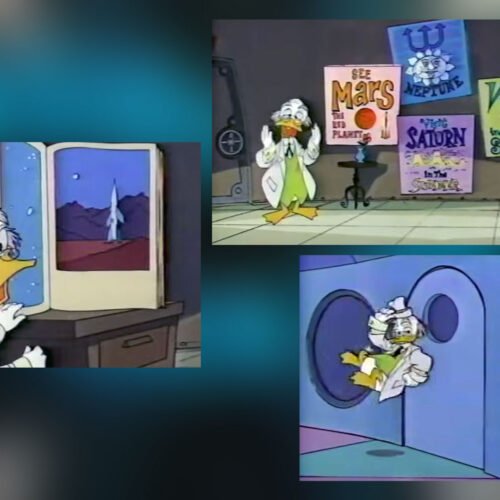
Sixty-five years after his television debut, historical archives reveal that Donald Duck's brilliant uncle, Ludwig Von Drake, was modeled in part after legendary German rocket scientist Wernher von Braun. The character served as Disney's premiere animated vehicle for introducing early Space Age science to millions of American households.
By Nexvoro Tech Wire
PUBLISHED FRI, SEP 25, 2026 1:05 AM UTC • 6 MIN READ
The Genesis of a Television Pioneer
Sixty-five years ago, on September 24, 1961, The Walt Disney Company introduced a television character designed specifically to command the small screen: Ludwig Von Drake. Billed by Disney himself as "the outstanding genius of the century," the brilliant and eccentric uncle of Donald Duck was characterized as a "renowned scientist, lecturer, psychologist [and] world traveler." For millions of American families tuning into NBC every Sunday to watch *Walt Disney's Wonderful World of Color*, Von Drake became the definitive animated educator, bridging complex technological concepts and scientific principles for a mainstream audience.
Over the subsequent years, the character tackled an eclectic array of subjects with confident eccentricity, ranging from the mechanics of color television and the physiological health benefits of exercise to the rich historical evolution of aviation. However, Von Drake truly found his stride when he ventured into the cosmic frontier. In the February 10, 1963, episode titled "Inside Outer Space," the animated polymath boldly claimed to have written the ultimate definitive guidebook on the cosmos, setting the stage for an ambitious blend of entertainment and mid-century scientific outreach.
"You people out there are going to see stars you have never seen before… when you go traveling in outer space," Von Drake declared at the opening of the televised segment, establishing a tone that was equal parts authoritative and whimsical. "In fact, there are going to be a lot of things out there you don't know about, but don't let it bother you, 'cause all of the answers is [sic] right in here. I call my guidebook Inside Outer Space because everything known about outer space is on the inside."
The Intersection of Animation and the Space Race
As time would prove, Von Drake's comedic bravado regarding his guidebook's timelessness was slightly misplaced, as the rapid pace of aerospace engineering quickly outpaced early speculative fiction. The production utilized recycled animation sequences pulled directly from earlier groundbreaking Disneyland television specials, including "Man and the Moon," "Man in Space," and "Mars and Beyond." These foundational segments had originally debuted on December 4, 1957, arriving mere months after the historic Soviet launch of Sputnik 1, the world's first artificial satellite.
Produced during a pivotal window before any human being had successfully ventured beyond Earth's atmosphere, these foundational episodes leaned heavily into speculative and occasionally fantastical territory. By the time "Inside Outer Space" premiered four years later in 1963, the geopolitical landscape of the Space Race had fundamentally transformed. Two Soviet cosmonauts had already successfully orbited the Earth, and two American astronauts had completed groundbreaking suborbital spaceflights - milestones of human achievement that went entirely unmentioned by the loquacious professor.
Despite the recycled footage and charmingly outdated projections, the animated segments served as a cultural bridge between emerging rocket science and public consciousness. The creative DNA linking Ludwig Von Drake to the earlier space-themed documentaries extended far beyond mere asset reuse. Disney's creative team intentionally wove real-world scientific authority into the very fabric of the character's persona, cementing a unique intersection between Hollywood animation and the burgeoning American space program.
Consulting the Architects of the Cosmos
To ensure their broadcast programming maintained a credible grip on scientific reality - at least by the standards of the late 1950s - director and animator Ward Kimball, alongside Walt Disney himself, established direct channels with elite aerospace pioneers. The studio brought on German rocket scientist Wernher von Braun, renowned physicist Heinz Haber, and prolific science writer Willy Ley as expert consultants. Their collective efforts to popularize the mechanics of space exploration have since been widely credited by historians with giving NASA a vital foothold in the public perception during the intense height of the Space Race.
The profound influence of von Braun, Haber, and Ley extended directly into the writers' room. When Disney, writer Bill Berg, and animator Milt Kahl sat down to conceptualize Ludwig Von Drake, they drew heavily from Haber and Ley's expansive breadth of technical knowledge while channeling von Braun's distinct professional expertise and charismatic personality. To complete the transatlantic scholarly archetype, voice actor Paul Frees provided Von Drake with a pronounced Austrian accent - a notable creative choice given that World War II remained a fresh memory for American television viewers.
The real-world inspiration behind the character even bled out into live-action banter during production. In his introductory remarks for the "Inside Outer Space" broadcast, Walt Disney accidentally revealed the direct human muse driving the character's creation. Stumbling momentarily over his lines on camera, Disney introduced the animated host by stating, "The world-famous authority on outer space, Professor Wernher von… I mean… Ludwig Von Drake," permanently tying the legendary rocket scientist to the legacy of Duckburg's most eccentric academic.
Reporting synthesized under Nexvoro.tech Editorial Standards • Referenced via Ars Technica
Verified Dispatch