As Beijing mulls opening its doors to millions of banned Nvidia chips, industry insiders scrutinize CEO Jensen Huang's mounting influence over the White House. Critics worry corporate profit incentives are overshadowing national security and catastrophic risk warnings.
Geopolitical Standoff: The US-China AI Summit and Tenuous Trade Truces
On its face, the recent high-stakes summit between Donald Trump and China's president Xi Jinping didn't fundamentally alter the global landscape of artificial intelligence regulation. Export controls were notably absent from substantive discussions, with neither superpower seemingly inclined to offer meaningful regulatory concessions. Instead, an already precarious trade truce was temporarily extended for a mere two months, leaving analysts to warn that looming US controls could drop at any moment and trigger immediate retaliation from Beijing - specifically through cutting off critical exports of rare earth elements.
However, operating quietly in the background of these shaky diplomatic talks, semiconductor titan Nvidia appeared to notch a significant strategic victory. According to reports, China is currently mulling relaxing its domestic controls to allow some of its largest and most influential artificial intelligence firms to import perhaps millions more of Nvidia's previously banned chips over the coming year. This shifting regulatory posture highlights the complex interplay between macroeconomic statecraft and corporate lobbying in the trillion-dollar semiconductor sector.
Sources familiar with confidential deliberations told *The Information* that China's primary tech oversight arm, the Ministry of Industry and Information Technology, recently asked domestic giants Alibaba and ByteDance to share detailed strategic plans regarding the potential purchase of Nvidia's RTX Pro 5500 chips. Although these components are technically classified as gaming hardware, Chinese regulators instructed firms to outline how they intend to deploy them, with widespread expectations that the chips could be integrated into enterprise servers to power the nation's most resource-intensive AI models.
The Presidential Pivot: From Skepticism to Mar-a-Lago Alignment
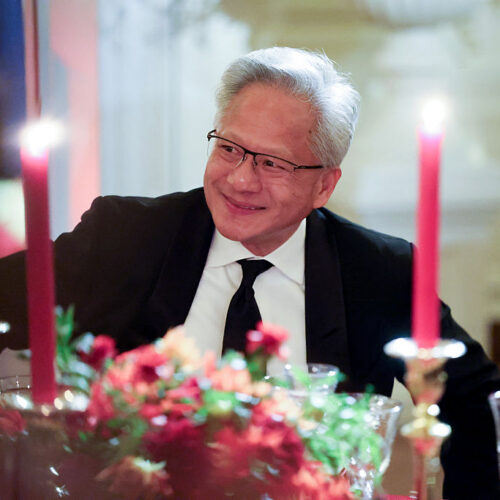
As Nvidia's market influence expands, President Trump increasingly looks to Nvidia CEO Jensen Huang for direct guidance on artificial intelligence strategy. Yet, this cozy relationship has ignited a fierce debate across Washington and Silicon Valley, where stakeholders are deeply divided over whether what is demonstrably good for Nvidia is equally beneficial for the United States. Already holding the title of the world's most valuable publicly traded corporation, Nvidia stands to profit enormously in an economic environment where catastrophic risks are minimized and both superpowers prioritize rapid frontier AI development without pumping the brakes.
Critics worry that Nvidia's powerful profit motivations may be unduly steering the executive branch's thinking at a pivotal historical moment - one where a president's precise understanding of frontier technological risk is paramount. For Nvidia, securing market access in mainland China has remained a paramount corporate objective ever since Trump assumed office. Huang has publicly and privately blamed previous US export controls for eviscerating Nvidia's dominant share of China's advanced AI chip market, driving it down from roughly 95 percent to absolute zero, as documented by *The Information*.
Trump was not initially an ally to the chipmaker. Upon entering office, he famously questioned executive competence by asking, "What the hell is Nvidia?" Rather than immediately loosening the strict export controls established during the Joe Biden administration, Trump initially tightened them further, most notably by banning the export of advanced H200 chips to China. At the time, the administration even weighed breaking Nvidia up entirely, operating on the theory that fostering domestic competition among rival chipmakers was essential for the United States to win the overarching geopolitical "AI race" against Beijing.
The Executive Dinner and the Rise of Jensen Huang's Advisory Clout
That adversarial posture shifted dramatically following a private dinner meeting between Trump and Huang at the Mar-a-Lago resort. According to subsequent accounts, Trump remarked that he finally "learned the facts of life" regarding the semiconductor industry and came to appreciate Nvidia as an extraordinary corporate AI leader. Ignoring persistent warnings from congressional lawmakers and national security hawks, Trump subsequently lifted the export controls on H200 chips - a regulatory reversal that Beijing eventually matched by allowing select domestic firms to purchase them.
In the months following this decisive meeting, Trump and Huang have appeared together in public repeatedly and maintain regular communication via phone, according to insights shared by Stephen Witt, author of *The Thinking Machine: Jensen Huang, Nvidia, And The World's Most Coveted Microchip*. In an interview discussing Huang's sweeping influence over executive policy, Witt told NPR that recent statements from Trump dismissing existential AI risks as a "hoax" and framing the technology purely as an economic boon mirror "exactly Jensen's talking points."
"Jensen is now the president's most influential adviser on technology issues," Witt told NPR, emphasizing how close the two figures have become. Witt noted that during his extensive reporting, he spent time with numerous figures across the broader hardware ecosystem who share Huang's worldview. Much like the Nvidia chief executive, these hardware leaders routinely downplay the catastrophic software risks that application developers - including prominent Nvidia enterprise customers like Anthropic and OpenAI - have repeatedly urged the White House to take seriously.
Architectural Realities and the Divergence of Hardware vs. Software Perspectives
The fundamental philosophical split highlighted by Witt underscores a profound structural divide within the contemporary technology sector. While software developers focused on frontier reasoning models and autonomous agent architectures advocate for stringent federal guardrails, hardware manufacturers operate with a fundamentally different commercial calculus. "Most of the hardware people, most of the people who designed the networking equipment and the microchips, feel like Jensen does," Witt explained, observing that engineering leaders tied directly to silicon production tend to maintain a markedly lower perception of existential risk.
This low risk-appetite among hardware architects directly informs the commercial imperatives driving Nvidia's product roadmap and its aggressive push for foreign market access. As Chinese regulators evaluate the integration of RTX Pro 5500 chips into server clusters, the economic gravity of the global semiconductor market continues to pull Washington and Beijing into a complex dance of interdependence. Even as lawmakers draft prospective export controls that threaten to upend the fragile two-month trade extension, the executive branch's receptiveness to industry lobbying suggests that market forces will remain a formidable counterweight to geopolitical decoupling.
Ultimately, the intersection of Nvidia's corporate ambitions and White House policymaking illuminates the high-stakes reality of modern technological governance. With Jensen Huang firmly established as a central presidential whisperer on matters of digital innovation, the future of international trade restrictions, domestic market competition, and global AI safety standards hangs in the balance. As Beijing deliberates on clearing millions of restricted chips for enterprise deployment, the tension between maximizing corporate capitalization and safeguarding national security will undoubtedly define the next chapter of the American tech economy.
Reporting synthesized under Nexvoro.tech Editorial Standards • Referenced via Ars Technica
Verified Dispatch