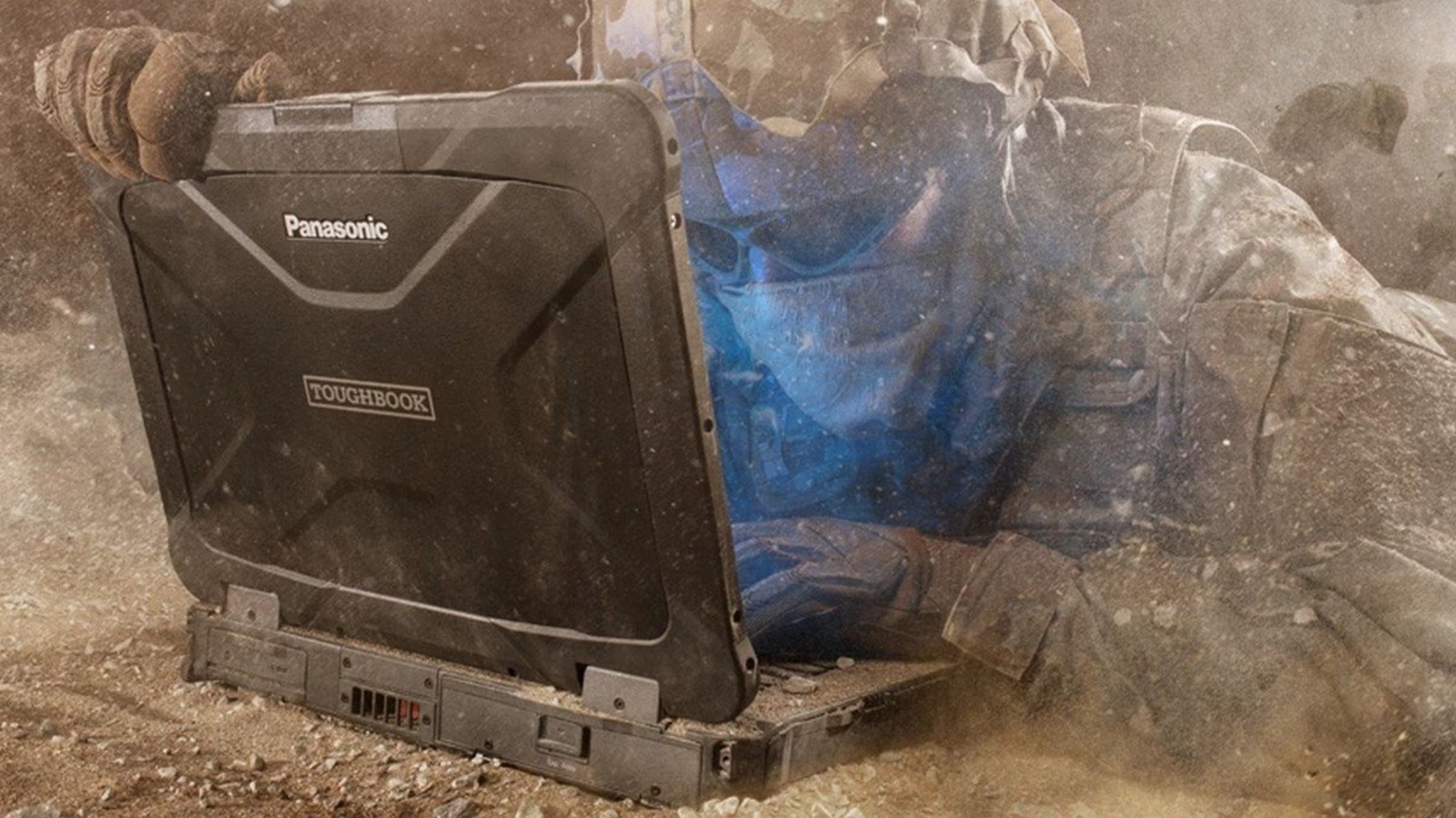
Despite boasting near-indestructible chassis, all-weather durability, and multi-day swappable power systems, rugged laptops remain firmly locked in military, industrial, and enterprise niches. An examination of supply chains, silicon lifecycles, and consumer ergonomics explains why these heavy-duty machines will never displace the ultra-thin notebook.
The Ergonomic and Aesthetic Chasm in Personal Computing
Walk into any executive boardroom, university library, or metropolitan coffee shop from Seattle to New York, and the hardware landscape is virtually homogenous: razor-thin, anodized aluminum chassis, edge-to-edge glass displays, and weights hovering comfortably under three pounds. What you will almost never encounter is a Panasonic Toughbook, a Dell Latitude Rugged Extreme, or a Getac enterprise workstation.
These reinforced machines represent a multi-billion-dollar specialized hardware sector engineered to survive five-foot drops onto jagged concrete, sub-zero arctic temperatures, torrential downpours, and explosive atmospheres. Yet, despite decades of relentless improvements in mobile computing, the rugged laptop has failed—and arguably never intended—to cross the chasm into general consumer adoption. The disconnect is not merely a matter of marketing; it is an architectural, financial, and strategic divide rooted in the fundamental trade-offs between consumer portability and industrial survivability.
The Physics of Over-Engineering: Beyond MIL-STD-810H
To understand why rugged machines remain alien to ordinary buyers, one must first dissect the physical bill of materials (BOM). True fully rugged laptops are certified under rigorous standards, most notably MIL-STD-810H and Ingress Protection ratings like IP65 or IP66. Achieving these certifications requires mechanical accommodations that directly oppose consumer design trends.
While consumer original equipment manufacturers (OEMs) like Apple, Dell, and HP shave millimeters off display bezels and chassis profiles, rugged manufacturers reinforce their systems with thick magnesium alloy internal frames, elastomeric rubber corner bumpers, and mechanical door latches covering every port. Optical bonding processes—injecting high-grade polymer resin between the capacitive touch panel and the underlying LCD—are required to eliminate air gaps, reduce internal reflections, and enable 1,000-to-1,500-nit direct-sunlight readability.
Furthermore, these displays must be operable while wearing heavy work gloves or in heavy rain, requiring specialized resistive or dual-mode digitizers. The inevitable consequence of these physics-driven necessities is a machine that often measures over two inches thick and weighs between six and ten pounds. For an emergency medical technician, oil rig engineer, or defense operator, that bulk is an insurance policy; for an office worker or mobile developer, it is an intolerable ergonomic liability.
Silicon Latency: The Enterprise Qualification Bottleneck
In the consumer marketplace, product cycles move at breakneck speed. Laptop makers refresh their lineups every 12 months to incorporate Intel’s latest Core Ultra architectures, AMD’s newest Ryzen processors, or Qualcomm’s ARM-based Snapdragon silicon. For rugged OEMs, this rapid silicon cadence is practically impossible.
Rugged systems undergo exhaustive environmental, electromagnetic interference (EMI), and thermal qualification cycles that frequently take between 12 and 24 months before entering production. Deploying a new architecture into a sealed, fanless, or ingress-protected thermal envelope requires bespoke passive heat dissipation architectures, liquid cooling loops, or specialized thermal transfer blocks.
Consequently, rugged laptops often hit the enterprise market with previous-generation or mid-tier enterprise processors. While enterprise fleet managers prioritize stability, long-term driver certification, and Intel vPro remote management over raw benchmark supremacy, retail consumers measuring price-to-performance ratios balk at spending $4,000 on a laptop equipped with a silicon generation trailing current consumer flagships.
The Economics of Durability: B2B TCO vs. Consumer Planned Obsolescence
The pricing structure of rugged hardware completely alienates the retail marketplace. A baseline enterprise rugged laptop typically starts between $3,000 and $5,000, quickly escalating past $7,000 when outfitted with secondary hot-swappable batteries, dedicated GPS modules, or integrated smart card readers.
This pricing model is predicated on Total Cost of Ownership (TCO) analytics. Enterprise, utility, and defense procurement departments calculate the cost of a device over a five-to-seven-year deployment cycle. In harsh operating environments, standard consumer laptops exhibit annual failure rates exceeding 15% to 20%, incurring crippling downtime, field repair costs, and data loss. A fully rugged system, by contrast, drops annual failure rates below 2%, easily justifying its upfront capital expenditure within enterprise balance sheets.
Conversely, the consumer device market operates under a consumer replacement cycle of three to four years, driven by software feature creep, aesthetic wear, and battery degradation. Mainstream consumers are economically incentivized to purchase a $1,000 ultrabook and rely on inexpensive accidental damage insurance or lightweight protective sleeves rather than amortizing a multi-thousand-dollar rugged platform over half a decade.
Legacy Interfaces and the B2B Channel Moat
A critical factor preserving the rugged laptop’s enterprise isolation is its input/output ecosystem. Consumer notebooks have ruthlessly standardized on minimalist USB-C and Thunderbolt architectures, offloading legacy connectivity to dongles and hubs. Rugged notebooks, however, must interface with legacy industrial equipment, proprietary avionics, medical diagnostics, and telecommunications nodes.
It is entirely standard to find native RS-232 serial ports, dual Gigabit RJ45 Ethernet jacks, VGA outputs, modular expansion bays, and Fischer connectors integrated directly into the chassis of a modern rugged machine. These interfaces require physical board space, complex internal trace routing, and dedicated controller chips that offer zero utility to the modern consumer streaming video or writing code in a coffee shop.
Moreover, the distribution channels are entirely decoupled from traditional retail. Companies like Panasonic, Getac, and Durabook do not sell primarily through consumer retail storefronts. Their supply chains flow through specialized Value-Added Resellers (VARs), defense prime contractors, and systems integrators who bundle hardware with custom software suites, mounting docks for law enforcement vehicles, and extended multi-year service-level agreements (SLAs).
The Strategic Horizon: Semi-Ruggedization and the Hybrid Workforce
While fully rugged tanks will remain sequestered in industrial sectors, the line between consumer fragility and enterprise durability is subtly blurring. The rise of hybrid field work, extreme outdoor content creation, and mobile logistics has created a burgeoning sub-tier: the semi-rugged and 'prosumer rugged' category.
Manufacturers are increasingly leveraging lightweight carbon-fiber composites, Gorilla Glass ceramic formulations, and spill-resistant internal keyboard trays to bestow standard consumer laptops with modest environmental resistance without sacrificing thin-and-light form factors. Features like MIL-STD-810H drop testing are now routinely cited in marketing materials for consumer flagships like the ThinkPad X1 Carbon or Asus ZenBook.
Nevertheless, the true fully rugged laptop remains a masterclass in domain-specific engineering. It serves as a reminder that when the physical environment is hostile, form must uncompromisingly follow function. For corporate professionals and software engineers operating in climate-controlled environments, the sleek, fragile ultrabook will continue to reign supreme—leaving the indestructible magnesium fortresses to the frontlines of global industry.