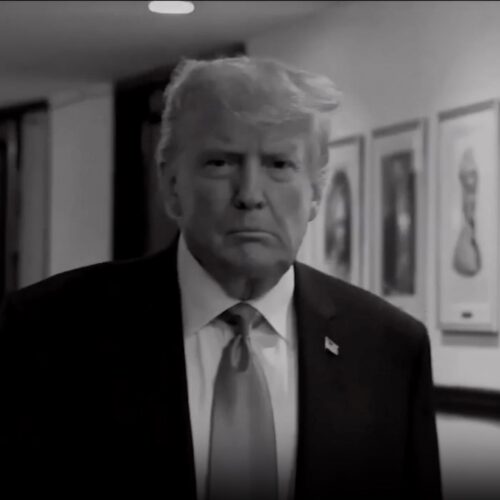
President Donald Trump announced a purported official rebrand of artificial intelligence to 'super intelligence' during a surprise White House press appearance alongside tech executives. The move comes as new polling data reveals mounting public anxiety regarding the rapid advancement of tech and disapproval of the administration's policy handling.
By Nexvoro Tech Wire
PUBLISHED TUE, SEP 29, 2026 10:36 PM UTC • 6 MIN READ
The White House Gathering and the 'Super Intelligence' Declaration
President Donald Trump announced on Tuesday that he signed a document purporting to "officially" change the name of artificial intelligence to "super intelligence." The high-profile event marked a forced rebrand for an industry that the administration has tightly embraced, even as everyday Americans grow increasingly concerned about the rapidly advancing technology. Speaking to reporters on the White House grounds while flanked by prominent tech executives, Trump suggested that the document asserting the new name was signed by the leaders of a slew of artificial intelligence and technology giants who had convened at the complex for a lunch meeting with the president.
"We've changed the name officially today," Trump stated to reporters during the unusual press gathering situated just outside the White House's West Wing, noting he was not initially expected to appear. "The name has been officially changed by the biggest, the smartest, the greatest people anywhere in the world." When pressed by journalists regarding whether the newly signed document carried any binding legal weight, Trump candidly responded that the agreement is "morally binding." Specifics regarding the exact language, legal framework, or implementation of the document remained unclear following the event, and the White House did not immediately respond to requests for additional information from major news outlets.
This latest branding initiative follows a recent crowdsourcing effort deployed by Trump last week, during which he asked his social media followers in a public poll whether they preferred the nomenclature "SUPER INTELLIGENCE" or "SUPERIOR INTELLIGENCE." The tactic mirrors a pattern of executive renamings favored by Trump throughout his extensive careers in both the business and political sectors. Last month, during a flare-up in diplomatic relations between the United States and Canada, Trump signed an executive order asserting that Lake Ontario should be officially renamed "Lake America." Similarly, immediately after taking office last year, he signed an executive order dictating that the Gulf of Mexico be renamed the "Gulf of America."
Legislative Context and the White House Accord on Superintelligence
House Speaker Mike Johnson, R-La., who attended Tuesday's high-level luncheon, addressed reporters prior to Trump's impromptu appearance on the grounds. Johnson clarified that the gathered tech executives and leaders had formally signed a "statement of principles" officially titled "The White House Accord on Superintelligence: A Joint Commitment on Frontier SI Responsibilities." According to the House Speaker, the document establishes an industry framework designed to address safety concerns while maintaining robust technological momentum across the American enterprise ecosystem.
Summarizing the contents of the accord, Johnson explained that the document encompasses "voluntary" commitments executed "on behalf of the industry," alongside provisions for "robust internal controls" and multiple "layers of internal and external review." When defending the balance between technological expansion and regulatory oversight, Johnson asserted to the press corps that "safety and innovation are not mutually exclusive pursuits." Republican congressional leadership continues to emphasize that domestic technological leadership remains an absolute national priority, framing the domestic artificial intelligence sector as a critical frontier for maintaining national competitiveness.
Furthermore, Johnson noted that GOP incumbents are in broad agreement that the United States cannot afford to lose its technological edge over foreign competitors, particularly China, in the global race for artificial intelligence dominance. The legislative framing attempts to tie domestic AI development directly to national security imperatives, arguing that rigorous internal corporate reviews and voluntary compliance frameworks are sufficient to manage long-term systemic risks without imposing heavy-handed government mandates that could stifle startup innovation or corporate investment.
Public Sentiment, Polling Pressures, and Safety Guardrails
Despite the optimistic framing presented by political leaders and corporate executives at the White House luncheon, recent national polling data paints a significantly more complex picture of public sentiment. Majorities of Americans have expressed mounting fear and concern regarding the societal impacts of artificial intelligence, alongside growing disapproval of Trump's handling of the technology portfolio. As the technology sector races toward advanced artificial general intelligence capabilities, the disconnect between elite industry enthusiasm and consumer unease has emerged as a prominent political liability.
When questioned by reporters why the general public should not be deeply concerned about artificial intelligence, and why the administration continues to resist government-mandated safety guardrails, Trump offered a succinct justification. "Because we have people that love our country and love the world a lot," Trump remarked, placing his trust in the goodwill of domestic tech leaders rather than bureaucratic regulatory enforcement. Additionally, when asked if he harbored political concerns that his aggressive support for artificial intelligence and massive data center developments could negatively impact Republican candidates in the upcoming midterm elections, Trump simply shrugged off the inquiry.
As the political calendar marches toward the midterms, the intersection of advanced technology infrastructure, energy consumption, and public safety is rapidly transforming into a central battleground issue. While industry leaders champion the economic upside of frontier technological investments, political strategists are closely monitoring whether consumer anxiety over automation, data privacy, and existential tech risks will translate into tangible electoral consequences at the ballot box.
Reporting synthesized under Nexvoro.tech Editorial Standards • Referenced via CNBC Top News
Verified Dispatch