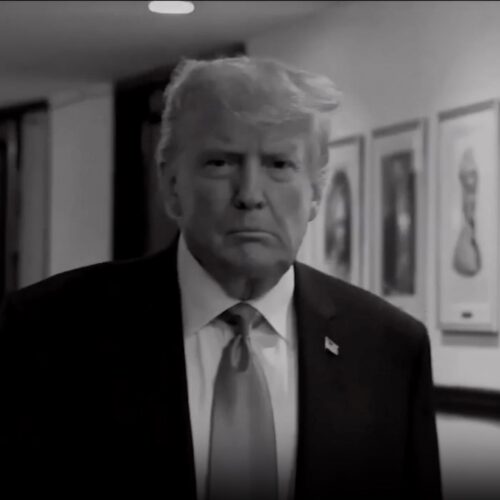
President Donald Trump has signed a new executive order mandating that all US executive branch agencies, policy documents, and press releases replace the term 'artificial intelligence' with 'Super Intelligence.' The sweeping policy shift was announced alongside high-profile tech executives including Nvidia CEO Jensen Huang and Tesla CEO Elon Musk.
By Nexvoro Tech Wire
PUBLISHED TUE, SEP 29, 2026 10:37 PM UTC • 6 MIN READ
A New Lexicon for Federal Policy
The United States executive branch is no longer officially acknowledging the existence of 'artificial intelligence.' Under a new executive order signed by President Donald Trump, official policy websites, federal policy documents, and press releases will henceforth refer exclusively to 'Super Intelligence.' This linguistic pivot aims to reshape how the federal government communicates about and approaches the fastest-growing sector of the modern technology landscape.
Elaborating on the rationale behind the rebrand during an event announcing the launch of America.gov earlier on Tuesday, President Trump championed the chosen nomenclature. 'The word super is the best word of all, and it's the simplest,' Trump stated, adding that Chinese President Xi Jinping, who visited the White House the previous week, 'loves it,' too. The administration's stance is that the older terminology fails to capture the true nature of the technology.
'We don't want to hear artificial. Because it's not artificial. It's very powerful, it's very brilliant,' Trump declared. He emphasized that the technology is 'going to mostly be put to good use and we'll stop the bad use.' Comparing the old label unfavorably to contemporary media landscapes, Trump added that 'artificial' is 'like the news. Fake news.' The president first introduced plans for this sweeping rebrand during a major speech delivered to the United Nations General Assembly the prior week, framing the initiative as a way to quell public and international fears over AI advancing too quickly and posing unforeseen safety risks.
Implementation and Regulatory Shifts Across Agencies
While executive agencies will not be legally required to retroactively alter past regulations or historical documents, the policy nonetheless constitutes a real and uniquely unconventional shift in federal administration. In technical industry circles, 'superintelligence' has traditionally served as one of several terms used to describe particularly powerful, hypothetical future versions of artificial intelligence. However, the Trump administration is actively seeking to leverage the term as a direct statutory and operational replacement for the broader definition of AI.
Under the newly established protocols, federal officials will be expected to avoid even acknowledging the use of the terms 'artificial intelligence' or 'AI' across all relevant settings. This semantic realignment requires a wholesale adjustment in how bureaucratic entities draft technical guidelines, public communications, and inter-agency reports. Although past statutory frameworks remain intact on paper, the rhetorical posture of the United States government has undergone an immediate and highly visible transformation.
This administrative overhaul follows closely on the heels of strategic high-level discussions between the White House and leaders of the American technology sector. The executive order itself was formally signed immediately following a private luncheon hosted by President Trump at the White House, where prominent tech chief executive officers and senior government officials gathered to discuss the newly christened 'Super Intelligence' paradigm and its myriad implications for the national economy.
Industry Alignment and Private Sector Consultations
During brief public remarks delivered immediately after the high-stakes White House meeting, President Trump characterized the luncheon as 'very productive' and 'extremely friendly.' Flanked by Nvidia CEO Jensen Huang and Tesla and SpaceX CEO Elon Musk, alongside a packed room of other prominent industry attendees, the president outlined the administration's current philosophy regarding corporate oversight and technological expansion within the booming sector.
Addressing the delicate balance between innovation and governance, Trump noted, 'There's a belief that there should be tremendous self-regulation. And we automatically have regulation with the Department of Justice, the FBI, all of that.' This approach signals a preference for market-driven development backed by traditional federal law enforcement backstops rather than heavy-handed preemptive regulatory agencies specifically tailored to monitor code and neural networks.
The conversation also touched heavily upon physical infrastructure constraints, particularly the monumental power and real estate requirements necessary to support next-generation computing workloads. On the local level, where major technology firms have increasingly encountered significant community pushback and regulatory hurdles in building out the massive data centers required to run their services, Trump offered a pragmatic reassurance. He asserted that these firms will proactively 'work to make the community happy' by providing essential local resources and economic support, ultimately predicting that 'data centers are going to be very popular.'
Reporting synthesized under Nexvoro.tech Editorial Standards • Referenced via The Verge
Verified Dispatch