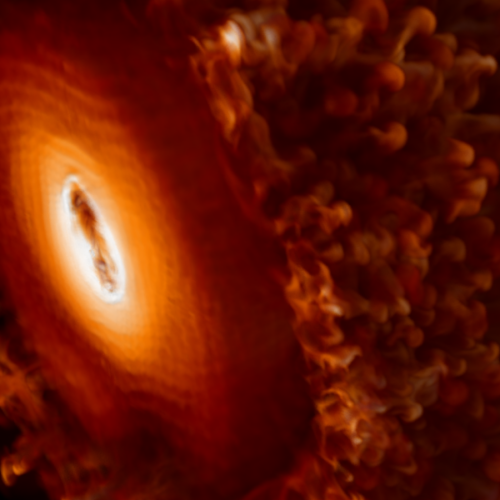
Identity-fluid particles may carry some energy out, leading to direct collapse.
Primary Journalistic Dispatch & Direct Reporting
Identity-fluid particles may carry some energy out, leading to direct collapse.
Our basic understanding of core-collapse supernovae hasn't changed in decades. Large stars burn through all the fuel at their cores and start creating heavier elements in reactions that consume energy. The lack of energy from these reactions allows gravity to pull the interior of the star in on itself, collapsing it into a neutron star or black hole. The energy released by this process then blows the remainder of the star apart.
And, generally, that's right. But there's an entire busload of devils in the details. The statistics of supernovae that we've observed indicate that the model may be seriously incomplete. And on the theoretical side, there are still plenty of uncertainties, including over some of the basics, such as whether all core collapses actually result in a supernova.
In-Depth Developments & Factual Context
A paper being released by Physical Review D provides what might be a potential explanation for the discrepancy: flavor-changing neutrinos. Neutrinos play a key role in our current models of supernovae, and right now, those models don't take into account one of neutrinos' most striking features: their ability to change identity.
We've observed plenty of supernovae, so it would seem like there would be little mystery left. But a number of observations suggest there are some subtleties that we might be missing. For example, if we compare the rate of star formation in the Universe to the frequency of supernovae, there's a discrepancy; it appears we're forming enough stars to fuel a much higher frequency of supernovae than we actually observe. Also, in cases where we can identify the progenitor star that exploded, we find too few red supergiants, indicating that they may be contributing to this discrepancy.
Other problems come from observations of gravitational waves generated by mergers of the black holes left behind after a supernova. These mergers suggest there's a "mass gap" in black hole formation - a range of masses where there are fewer black holes than you'd expect from an even distribution. But that data is complicated by the fact that theorists haven't definitively identified the conditions that determine when a neutron star tips over into a black hole instead.
Industry Impact & Strategic Analysis
Meanwhile, on the theory side, things have been in a bit of flux. As we've added ever more sophisticated physics to our models of supernovae, we've gone through periods where either everything blows up or nothing blows up. It has been harder to develop models that give us a good picture of why some stars blow up and others might not.
Still, our best current models agree that neutrinos are essential to the process. Neutrinos are produced in prodigious quantities both by the complex fusion reactions that take place during a supernova and by the formation of neutron star material at the heart of the collapse (which happens even if the collapse continues on to form a black hole). And those numbers matter for the fate of the material outside the core of the dying star.
With fewer photons coming out of the core of the star, that material lacks the energy to resist the pull of gravity and starts rushing toward the core. On its way, it encounters the shock wave from the formation of a neutron star/black hole, which is rushing in the opposite direction. Left on its own, these forces roughly balance out, stalling the shock wave and letting gravity take over.
Forward Outlook & Market Perspective
Neutrinos change the equation . While they tend not to interact with matter often, the sheer number of them rushing out ensures that enough bump into the material around the stalled shock wave. This transfers energy, heating it up enough to overcome gravity and allow the shock wave to escape, destroying the star. Failure of this process would, in contrast, allow almost the entire contents of the star to collapse into a black hole, killing the star without an explosion.
One potential problem with the models that show neutrino heating is that they treat neutrinos as a single factor. Neutrinos don't want to be pinned down that way. There are three types, or flavors, of neutrino (electron, muon, and tau). But each particle is in a superposition of all three flavors and can shift among them in a process called flavor oscillation. So, even if the events inside the supernova produced nothing but electron neutrinos, they would likely oscillate among the two other identities multiple times before they reach the surface of the star.
And that's potentially a big deal, given that the neutrinos' interactions with matter are influenced by their identity. "By modifying the relative spectra of electron neutrinos, electron antineutrinos, and heavy-lepton neutrinos," the paper's authors write, "[flavor oscillation] affects charged-current heating and cooling in the region behind the shock."
The actual physics here is incredibly complicated, since the momentum of each neutrino will vary, as will where they are created relative to the center of the star. This will influence how far they can travel before experiencing a flavor oscillation and how many times they oscillate within the star. The researchers involved here, Mariam Gogilashvili and Irene Tamborra of the University of Copenhagen, aren't going for a physically exacting model of all of this complexity.
Instead, the two researchers use a simplified model where flavor changes occur roughly instantaneously, and the energy carried by neutrinos is divided evenly among the six types of neutrinos (electron, muon, tau, and their antiparticles). They apply this division of energy in their model as neutrinos travel through the space between the star's core (where neutrinos are coupled with matter) and the higher-density matter of the shock wave. They test three different density cutoffs to define the shock wave, giving a range of potential estimates of the impact.
Given their model, the researchers simulate the deaths of nearly 200 progenitor stars, ranging in mass from nine times that of the Sun all the way up to 120 times.
Reporting synthesized and verified under Nexvoro.tech editorial guidelines. Full primary records referenced via Ars Technica.
Reporting synthesized under Nexvoro.tech Editorial Standards • Referenced via Ars Technica
Verified Dispatch